
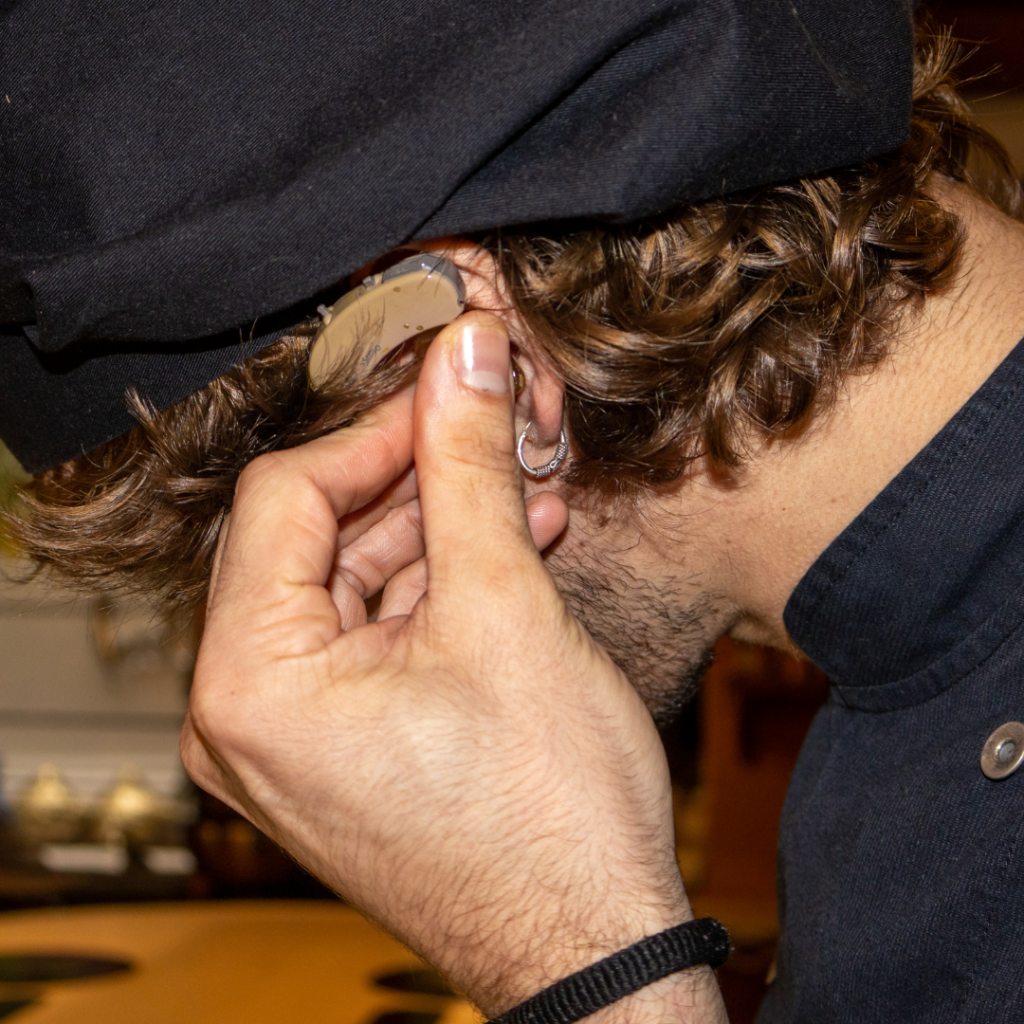
Following dinner conversations becomes challenging when high ambient noise interferes with your focus and hearing. Our specialists can evaluate hearing under both calm and noisy listening conditions to establish why noisy rooms present such difficulty. As soon as we identify the physiological cause of your difficult hearing, we deliver personalized rehabilitation options.
Explaining Normal Quiet Hearing Versus Restaurant Listening Fatigue
Low-noise environments yield an advantageous signal-to-noise ratio where primary speech remains significantly louder than background sound. Dining venues establish an entirely contrary auditory challenge. Overlapping chatter, piped music, kitchen clatter, and hard-surface reverberation mask speech, forcing the brain to expend immense cognitive effort to track conversation.
Such difficulty frequently signals sensorineural high-frequency hearing loss, auditory processing dysfunction, or noise-induced cochlear damage. Attention, fatigue, dim lighting, and distance from the speaker may make it worse. Many individuals register normal audiometric thresholds on standard pure-tone screenings yet show profound deficits during speech-in-noise testing. Consistent difficulty following restaurant conversation warrants clinical investigation even when everyday hearing seems largely unaffected.
How Audiologists Identify High-Frequency Hearing Loss
We begin with a history of the situations that cause trouble, along with questions about noise exposure, tinnitus, medications, family history, and changes in either ear.
Standard pure-tone audiometry gauges the lowest volume thresholds detectable across varying acoustic frequencies via specialized earphones and bone oscillators. Sensorineural high-frequency hearing loss demonstrates an audiometric slope reflecting diminished hearing thresholds as sound frequencies climb. Additional testing may include tympanometry to assess middle-ear function and word-recognition testing to measure speech understanding.
Since sound-treated booths cannot replicate the chaos of a crowded dining room, speech-in-noise testing provides critical real-world insight. It measures how well you recognize words or sentences as competing sounds become louder. In combination, these diagnostic metrics reveal whether communication hurdles involve audibility thresholds, speech discrimination, neural noise management, or mixed conditions.
Auditory Processing Disorders: Impact on Adult Communication
A diagnosed auditory processing disorder affects how the brain’s auditory cortex analyzes, organizes, and interprets sound. The ears may detect tones at expected levels, but the brain may have difficulty organizing competing signals, distinguishing similar speech sounds, or following rapid conversation. We first evaluate peripheral hearing and then determine whether an individualized auditory-processing test battery or referrals to other professionals are appropriate.
How to Improve Speech Clarity in Challenging Acoustic Environments
Minor environmental adjustments can boost speech acoustic signals and supply critical visual lip-reading cues. Prioritize dining at establishments designed with subdued acoustics or reserve tables during non-peak business hours. Facilities equipped with upholstered booths, acoustic baffles, fabric curtains, carpeted floors, and soft materials prove far easier on hearing than minimalist, hard-tiled spaces.
When arriving at the dining venue:
- Request table placement positioned away from dishwashing stations, bustling bars, sound speakers, and celebratory gatherings.
- Sit with a perimeter wall directly behind you to cut down on ambient noise approaching from the rear.
- Face your conversation partners in good lighting.
- Keep conversational proximity as close as comfortably feasible to preserve acoustic signal strength.
- Position your better-hearing ear directly toward your main conversational partner.
- Request that companions rephrase misunderstandings using different words rather than repeating the same sentence.
- Confirm important details rather than pretending to understand.
- Excuse yourself for a momentary quiet pause when listening exhaustion starts to mount.
- Ask companions to speak clearly at a natural pace.
- Yelling distorts natural speech formants and rarely makes spoken words easier to decipher.
The Best Hearing Devices for Overcoming Restaurant Noise
Selecting the ideal assistive technology depends upon underlying diagnosis, specific acoustic challenges, and verified hearing loss. Advanced hearing aids utilize beamforming directional microphones, adaptive noise reduction, and specialized restaurant programs to elevate voices directly ahead while suppressing ambient chatter. Users should establish realistic expectations because no hearing device can fully eradicate all unwanted ambient speech.
A remote microphone can provide a stronger improvement in the signal-to-noise ratio. Worn on the speaker’s collar or set on the table, the microphone broadcasts direct audio to paired hearing aids or specialized receivers. This wireless transmission substantially diminishes the acoustic degradation caused by physical distance and ambient room noise.
Other clinically valuable tools include:
- Table microphones for small-group conversations
- Hearing-loop telecoils that stream clean audio in loop-equipped establishments
- Mobile phone live-transcription apps offering real-time conversational subtitles
- Consumer wireless earbuds or hearables featuring customizable assistive listening modes
- Sound-level or restaurant-review tools for finding quieter locations
Our audiology staff helps you evaluate options, ensures wireless compatibility, and trains you on operating your chosen equipment.
How an Audiologist or Physician Can Improve Hearing in Noise
A professional clinical assessment moves beyond basic baseline statements like “I hear fine in quiet rooms.” We examine the challenging acoustic venues, conversational setups, and noise profiles you encounter to select appropriate diagnostic tests. The diagnostic battery may encompass pure-tone thresholds, acoustic middle-ear evaluations, suprathreshold word recognition, and speech-in-noise measures. Specialized auditory-processing testing can be ordered when patient history and preliminary audiometric findings warrant deeper neural investigation.
Hearing changes that present abruptly, affect only one side, or progress rapidly necessitate consultation with an ear, nose, and throat physician. Tailored audiological treatment identifies the exact origin of listening breakdown rather than assuming environmental dining noise is the sole culprit.
Request an Audiology and Hearing Evaluation Today
If crowded restaurant settings cause you to feel disconnected, tired, or forced to guess at conversations, arrange a diagnostic hearing evaluation today. We provide proven treatments to enhance your hearing in noisy environments, offering hearing aid fine-tuning, specialized assistive accessories, and individualized auditory therapy.
Contact our practice today to book your consultation and take a decisive step toward reconnecting in social settings.